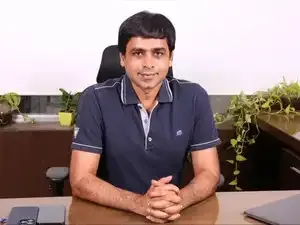
Nazara Technologies founder and non-executive director Nitish Mittersain
Regulatory uncertainty surrounding real-money gaming and retrospective GST notices continues to weigh on investor sentiment towards India’s gaming industry, even as the sector looks to attract fresh capital into video gaming, Nazara Technologies founder and non-executive director Nitish Mittersain said.
“Generally, people feel that gaming is problematic in India,” Mittersain told ET, adding that domestic and global investors were still trying to understand the regulatory environment.
Mittersain, who stepped down as Managing Director of Nazara Technologies on October 12 to become its Founder and Non-Executive Director, said the distinction between real-money gaming and video gaming had created uncertainty within the industry.
While real-money gaming companies had been able to monetise their businesses, video gaming companies had struggled to attract similar levels of investment.
Retrospective GST notices and the developments around real-money gaming have added to investor concerns, he said. “The smoke is taking some time and it’s still hazy.”
However, he expects capital to begin flowing into video gaming companies as regulatory uncertainty clears and the industry improves its monetisation capabilities. He cited Turkey and Vietnam as examples of markets that have developed gaming companies building products for global audiences.
“Monetisation is the biggest untapped potential in India,” Mittersain said, pointing out that around 500 million people play games on mobile phones, but relatively few pay for them. India's mobile-first gaming market has largely developed around free-to-play games supported by advertising, with a relatively low propensity among players to pay.
India’s gamer base reached an estimated 515–525 million in 2025, representing approximately 6% year-on-year growth, according to the FICCI-EY Media and Entertainment Report 2026. While the industry relies primarily on advertising and in-app purchases, Mittersain said the development of digital payments infrastructure and locally relevant games with global-quality content could support monetisation.
He said India did not need to match the conversion rates of overseas markets, given the size of its gaming audience. Even a smaller proportion of paying users could make a difference.
For Indian studios looking to expand internationally, he said product quality, speed to market and monetisation would be critical. He also suggested launching in the US and European markets first, where monetisation is easier, before identifying products suited to India.
“Made in India for the world is a large opportunity,” he said.
Artificial intelligence could also help Indian studios address some of their historical weaknesses in game design and monetisation, he said.
On evaluating gaming startups, Mittersain said he prioritises engagement and retention over headline download numbers. A game with 100,000 downloads would not, by itself, impress him. Instead, he looks at D30 retention, how frequently players return and the time they spend playing.
“If he comes and tells me my D30 retention is 20% or 10% or whatever that number is and my player is coming back three times a day to play, he is spending 30 minutes every day. Those are the metrics that will excite me,” he said.
Product stickiness, he added, must precede monetisation. “If you have a leaking bucket, no business is going to get built on top of that.”
Mittersain, who is part of the judges’ panel on Rusk Media’s Bharat Ke Super Founders Season 2, said he has invested in around 120 startups and remains actively involved in 98.
His interest in early-stage companies stems from his 27-year entrepreneurial journey at Nazara, his desire to learn from younger founders and his willingness to share experience in building businesses, mergers and acquisitions, and running a public company.
He said he evaluates founders on three parameters: passion, perseverance and positivity. Since business models can change over time, a founder’s ability to adapt and pivot is particularly important.
He also believes entrepreneurship will become increasingly important as artificial intelligence could reduce the number of new employment opportunities, making self-reliance and independent business creation more relevant.