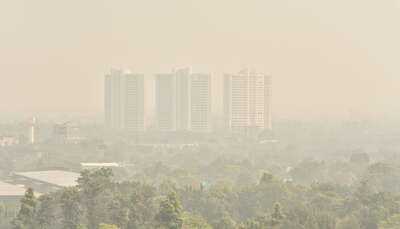
Gurgaon: Air quality in the city remained in the very poor category on Tuesday, with the city-level Air Quality Index (AQI) recorded at 323. Pollution levels varied sharply across the four active monitoring stations, with TERI Gram recording the highest AQI of 394. According to data, NISE Gwalpahari recorded an AQI of 356; Sector 51 recorded 307, while Vikas Sadan was the only station in the poor category, with an AQI of 237. The station-level data also showed significant differences in particulate matter concentrations, with TERI Gram recording the highest average PM2.5 and PM10 levels among the four stations.
The monitoring station recorded an AQI of 394, in the very poor category. Its average PM2.5 concentration was 394, with readings ranging from 219 to 500 in the preceding 24 hours. Average PM10 concentration stood at 295, with a minimum of 145 and a maximum of 440.
The station also recorded an average nitrogen dioxide (NO2) concentration of 53, ranging from 36 to 76, while ammonia (NH3) averaged 14, with readings between 11 and 20.
NISE Gwalpahari station recorded an AQI of 356, also in the very poor category. Average PM2.5 concentration stood at 356, with readings ranging from 11 to 461. Average PM10 concentration was 257, with a minimum of 149 and a maximum of 409. The station recorded an average NO2 concentration of 20, with readings between 9 and 52. Carbon monoxide (CO) averaged 65, with a minimum of 28 and a maximum of 102.
Sector 51 station recorded an AQI of 307, in the very poor category. Average PM2.5 concentration was 307, with readings ranging from 1 to 404. Average PM10 concentration stood at 227, with readings ranging from 1 to 376. The station recorded an average NO2 concentration of 40, with a minimum of 24 and a maximum of 68. Ammonia averaged 13, with readings ranging from 8 to 22.
Vikas Sadan station recorded an AQI of 237, in the poor category. Average PM2.5 concentration was 237, with readings ranging from 162 to 340. Average PM10 concentration stood at 188, with readings ranging from 106 to 255. The station recorded an average NO2 concentration of 19, with a minimum of 2 and a maximum of 63. Sulphur dioxide (SO2) averaged 17, with readings ranging from 6 to 22.
The city’s AQI calendar showed that Gurgaon recorded an AQI of 345 on Nov 9, up from 288 on Nov 8. The Nov 7 reading was also 345.
The city-level AQI reached 368 on Nov 6, the highest among the readings displayed for Nov 1 to 9. It was 331 on Nov 5, 322 on Nov 4, 305 on Nov 3, 246 on Nov 2 and 183 on Nov 1.
The Nov 10 reading of 324 was lower than the previous day’s 345 but remained in the very poor category. The calendar identified PM2.5 as the dominant pollutant on Nov 1, 2, 5, 6, 7, 8 and 9, while PM10 was the dominant pollutant on Nov 3 and 4. PM2.5 is the prominent pollutant for the city.
Bandana Mishra, Senior Consultant & HOD – Pulmonology & Respiratory Medicine, Manipal Hospitals Gurgaon, said, “Prolonged exposure to high levels of PM2.5 is an important contributing factor to the increasing burden of respiratory health problems. We are seeing concerns such as worsening asthma, COPD, chronic bronchitis, recurrent respiratory symptoms and reduced lung function. Long-term exposure can also increase the risk of developing respiratory diseases, including lung cancer. Children, senior citizens and individuals with pre-existing lung conditions are particularly vulnerable. However, respiratory illnesses are multifactorial, and air pollution is one of the major contributing factors rather than the sole cause.”
According to guidelines issued by the Central Pollution Control Board, when the AQI is in the ‘poor’ category, respiratory issues are experienced by most people due to prolonged exposure. An AQI between zero and 50 is considered ‘good’, 51 and 100 ‘satisfactory’, 101 and 200 ‘moderate’, 201 and 300 ‘poor’, 301 and 400 ‘very poor’ and 401 and 500 ‘severe’.
The Graded Response Action Plan (GRAP) in the NCR categorises the AQI into four stages: stage 1 (poor) for AQI between 201 and 300, stage 2 (very poor) for AQI between 301 and 400, stage 3 (severe) for AQI between 401 and 450 and stage 4 (severe+) for AQI above 450. Actions for stages 2, 3 and 4 are triggered at least three days in advance based on dynamic forecasts and meteorological predictions.
Contact to : xlf550402@gmail.com
Copyright © boyuanhulian 2020 - 2023. All Right Reserved.