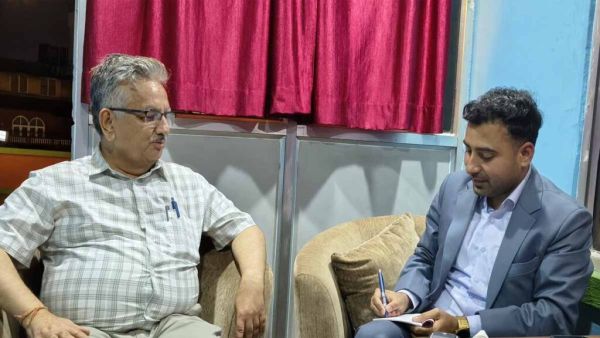
Nepal Political Reforms: Former Finance Minister of Nepal said – it is necessary to increase employment, production and investment; The public should get accounts of every promise and budget expenditure of the government.
Kumar Abhinav
Kathmandu/Read. There is no dearth of possibilities in Nepal's economy, but converting them into employment and income of common people (Nepal Political Reforms) remains a big challenge. Despite the vast potential for development in sectors like hydropower, tourism, agriculture and information technology, questions like unemployment, migration of youth abroad, dependence on imports and lack of investment are standing before Nepal. The earnings of Nepali workers working abroad are supporting the country's economy, while the need to increase domestic industry, production and employment opportunities is constantly being felt. of Nepal Former Finance Minister Surendra Pandey Believes that mere political majority or change of government does not lead to development. The real question is to what extent the benefits of government policies and budget are reaching the common citizen.
In a democracy, evaluation of the government's functioning and accountability to the public is equally important. With this in mind, there is a preparation to raise questions on the government's announcements, economic policies and actual achievements through the proposed 'Citizen Voice Campaign' in Nepal (Nepal Political Reforms). Former Finance Minister Surendra Pandey in a special conversation with national Hindi daily Read He spoke in detail on Nepal's economic challenges, political changes, corruption, India-Nepal relations, climate change and the future action plan of the Citizen Voice campaign. Here are the main excerpts from this special interview:
Question: What is the biggest challenge facing Nepal's economy?
Surendra Pandey: Nepal has vast development potential in sectors such as hydropower, tourism, agriculture and information technology. The biggest challenge is to convert these possibilities into production and employment. The benefits of economic development should reach the common citizen. Development will be meaningful only if farmers get fair price for their produce, employment to youth and financial assistance to small entrepreneurs.
Question: Why does economic crisis and public disappointment persist despite political majority?
Surendra Pandey: Majority gives the government the opportunity to take decisions, but does not guarantee economic achievements. The success of a government is determined by the results of its work. There should be regular evaluation of how much budget was spent, how many jobs were generated and how much public services improved.
Question: Is Nepal's increasing dependence on earnings from abroad a matter of concern?
Surendra Pandey : The earnings of Nepali workers working abroad are vital for millions of families. This fulfills education, health and domestic needs. But relying on this in the long run will not be enough. The capital coming from abroad should also be used for investment in agriculture, industry, tourism and other productive sectors within the country.
Question: How can migration of youth abroad be stopped?
Surendra Pandey : Youth will have to be given respectable employment and entrepreneurship opportunities in the country itself. It is necessary to strengthen technical training, vocational education, startups and easy loan system. The youth will have to be made not just job seekers but also employment creators.
Question: What is the most important step to control corruption?
Surendra Pandey: Transparency is necessary in government procurement, construction works and budget expenditure. The government should tell how much amount was given for which scheme, how much was spent and what benefits the public got. There should be impartial investigation in corruption cases. Questions should be raised on the basis of evidence and official documents rather than allegations.
Question: Why was the need felt to start 'Nagrik Awaaz Abhiyan'?
Surendra Pandey: The role of the public in democracy is not limited to voting only. Citizens have the right to ask questions on the functioning of the government and evaluate the schemes. The aim of the campaign is to support the good works of the government and highlight the shortcomings based on facts. It should not be limited to opposition to any one government or party.
Question: Can this campaign become a political party in the future?
Surendra Pandey: At present its concept is that of an independent citizen initiative. Its objective is not electoral politics, but to ensure accountability of the government and institutions on issues of public interest. The decision of any institutional change in future will depend on the people concerned and the prescribed process of the organization.
Question: In which direction should the economic relations between India and Nepal be taken forward?
Surendra Pandey: There is huge potential between the two countries in energy, trade, agro-processing, industrial investment and tourism. Both countries can get economic benefits especially by promoting religious tourism. For this, it is necessary to have better communication system, favorable policies and simplifying the payment system. Relations should be based on mutual respect and mutual interests.
Question: What demand should Nepal raise at the international level regarding climate change?A?
Surendra Pandey: For a mountainous country like Nepal, climate change is a serious issue to livelihood and economy. Risks such as glacial changes, floods and landslides are of increasing concern. Nepal should demand climate justice, technical assistance and financial support based on scientific evidence and the experiences of affected communities.
Question: How can the new generation change Nepal's economy?
Surendra Pandey: There are opportunities for youth in digital services, software, online business and tech entrepreneurship. For this, digital education, reliable internet, international payments and financial facilities will have to be improved. It is necessary to make the new generation an active partner in the economic progress of the country.
Preparation to ask 100 questions to the government
In the proposed Citizen Voice Campaign (Nepal Political Reforms), there is a plan to collect questions from citizens to employment, education, health, corruption, problems of farmers and workers. Along with sending these to the concerned ministries, a record of the government reply will also be kept. The focus of the campaign will be on presenting solutions with facts rather than raising questions only on social media.
Proposed action plan for first 100 days
- First 15 days: Organization, code of conduct and preparation of volunteers.
- Next 30 days: Collecting questions and problems from citizens.
- After this, 30 days: Studying government policies and budget and preparing a report.
- Last 25 days: Making the report public, submitting memorandum to the government and organizing public dialogue.
The focus of the campaign will be on these issues
- Employment generation and youth migration abroad.
- Examination of government budget expenditure and actual achievements.
- Transparency and accountability in matters of corruption.
- Improvement in education, health and agriculture system.
- Citizen Report Card of Government Announcements.
- Trade, energy and tourism cooperation between India and Nepal.
- Monitoring relief and rehabilitation in climate disasters.
Contact to : xlf550402@gmail.com
Copyright © boyuanhulian 2020 - 2023. All Right Reserved.