By: The Obnews Editorial Team
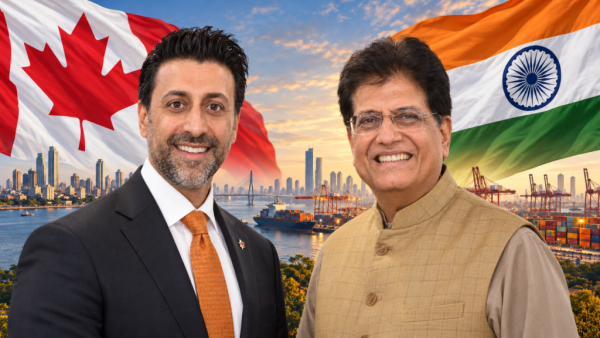
Canada is sending nearly 300 business delegates to India this week in what Global Affairs Canada describes as the country’s largest trade delegation to the Indian market in more than three decades. Led by International Trade Minister Maninder Sidhu, the October 12–17 mission includes stops in Mumbai and Bengaluru as Ottawa seeks new export opportunities, investment partnerships and progress toward a comprehensive trade agreement.
In a social media statement, Sidhu said previous trade missions to Japan, South Korea, Italy, the Gulf region and other markets had helped secure more than $10 billion in commercial deals, supporting thousands of Canadian jobs. He presented the India visit as the next step in that effort, with Canadian companies seeking connections to Indian buyers and business partners.


The mission’s agenda extends beyond the aerospace, agri-food and clean technology industries highlighted in Sidhu’s post. The Trade Commissioner Service also identifies information and communications technologies, life sciences, forestry and wood products among its priority sectors. Planned activities include business briefings, industry visits, networking and pre-arranged meetings for qualifying companies, with programming tailored to opportunities in each destination.
At the centre of the relationship is a shared ambition to increase annual bilateral trade to C$70 billion by 2030. Global Affairs Canada reports that two-way trade in goods and services totalled C$30.4 billion in 2025, illustrating the scale of the expansion the governments are seeking. The C$70 billion figure remains a future target, dependent on stronger commercial activity and improved market access.
Negotiations toward a Comprehensive Economic Partnership Agreement, or CEPA, are intended to help support that growth. Both governments have committed to working toward concluding talks by the end of 2026, and Sidhu discussed progress with Indian Commerce and Industry Minister Piyush Goyal ahead of a fifth negotiating round scheduled for October 5–9. Canada’s official agreement page continues to list CEPA as being under negotiation.
Canada’s published negotiating objectives include reducing tariffs and other trade barriers, improving access for service providers, strengthening investment protections and establishing clearer rules for digital trade. Ottawa is also seeking more predictable customs procedures and provisions that support smaller businesses. These are negotiating priorities; the final obligations and commercial benefits will depend on the terms both countries ultimately accept.

For Canadian exporters, the opportunities span established industries and emerging technologies. The Trade Commissioner Service identifies potential demand for food ingredients, specialty crops and plant proteins, alongside renewable energy, energy storage, water treatment and waste-management technologies. It also points to openings in medical equipment and biopharmaceuticals, while noting that businesses must account for local preferences and market-access requirements.
The trade push is taking place against the backdrop of a significant diplomatic rebuilding effort. Relations deteriorated in 2023 after Canadian authorities alleged Indian involvement in the killing of Sikh activist Hardeep Singh Nijjar in British Columbia. India denied the allegations, which contributed to a prolonged rupture between the two countries.
Prime Minister Mark Carney and Indian Prime Minister Narendra Modi subsequently pursued renewed engagement, including meetings in 2025 and Carney’s visit to India in early 2026. That visit produced a concrete example of expanding commercial ties: a C$2.6 billion agreement for Saskatoon-based Cameco to supply nearly 22 million pounds of uranium to India between 2027 and 2035. The leaders also announced initiatives involving critical minerals, technology, education and energy cooperation.
Economic discussions are continuing alongside security engagement. During an October 5–7 visit to India, David Morrison, the Canadian prime minister’s senior diplomatic and international affairs adviser, met Indian National Security Adviser Ajit Doval. Their discussions included progress on CEPA and cooperation addressing organized crime, terrorism, trafficking, cybercrime and extortion.
The India mission also forms part of Ottawa’s wider effort to expand exports beyond the United States. Canada has set a goal of doubling exports to other markets over the next decade, while pursuing trade negotiations with partners including the Association of Southeast Asian Nations and the Philippines. India is a central part of that diversification agenda.
For participating companies, the immediate objective is to turn introductions into customers, partnerships and investment. “I’m here to help our businesses find new customers and attract more investment to create good-paying jobs for Canadians,” Sidhu said in his post. The coming months will show how those business connections develop and whether negotiators can meet the governments’ year-end timetable.
Contact to : xlf550402@gmail.com
Copyright © boyuanhulian 2020 - 2023. All Right Reserved.