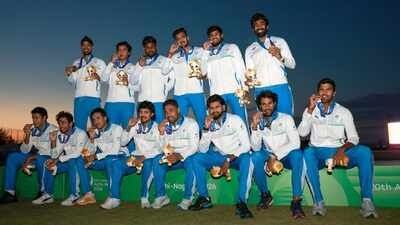
In international sports competitions, when a player hoists the tricolor flag on the podium after sweating for his country, the entire country celebrates his victory. The performance of the Indian team in the Asian Games has achieved historic success in the last few years. Be it the cricket field or other sporting events, Indian athletes have proved their mettle. But when players are showered with awards after winning medals, sometimes such shocking figures come to light which raise serious questions on the administrative system and policies of sports associations. Recently, the huge difference and discrimination seen in the prize money and financial incentives received by the players who won gold medals in the Asian Games has sparked a new debate in the sports world.
At the center of this entire controversy is a comparative study of the prize money received by the talented all-rounder Washington Sundar and other players of the Indian cricket team. According to media reports, when the Indian cricket team won the gold medal in the Asian Games, Washington Sundar, an important member of the team, was awarded prize money of about Rs 75 lakh by the state government or sports board. Washington Sundar played an important role in the team's victory with his excellent bowling and batting on the field during the tournament. On the contrary, another reserve player in the same squad, who did not get a chance to play even a single match during the entire tournament and who sat on the bench the entire time, got much more, i.e., crores of rupees, as per the rules or different quotas. As soon as this huge discrepancy came to light, sharp reactions started coming among sports lovers and experts.
Different sports policies and policies of different state governments are mainly considered responsible for this type of financial discrimination. In India, the central government and the Olympic Association have their own rules, but when it comes to honors and cash awards given by states, the standards are different for each state. Many state governments directly give huge amounts of Rs 2 to 3 crore and government jobs to their native players for winning medals in the Olympics and Asian Games. Since the players belong to different states, despite playing together in the same team and winning a gold medal, one player gets Rs 75 lakh, while another player gets a benefit of crores of rupees due to the policy of his state government. This administrative and policy disparity has often become a topic of discussion in the sports world.
Former players, sports experts and social media users have expressed strong objection to this inequality and discriminatory financial incentives. Critics argue that when the entire team has worked hard to compete for a common goal, and the player who comes out on the field and wins the match gets less money while the player who just remains a part of the team or remains in the reserves without playing a single match gets many times more money, then it is a complete injustice to the talent. This also affects the morale among the players. Sports lovers say that there should be a uniform and transparent national awards policy for all the players playing for the country, so that such regional or policy discrimination can be avoided and the hard work of every player can be properly evaluated.
This latest episode at the Asian Games has once again emphasized the need for India's sports administration to make major reforms in its financial policies. If the country has to become a sports superpower, it will be essential to remove such discrepancies in the encouragement and respect given to players. Be it cricket or other sports, every athlete who brings glory to the country should be respected. It is expected that after such cases come to light, the Sports Ministry and the concerned boards will make such transparent policies in future so that no player has to face such financial discrimination in future and everyone can be respected equally.
Contact to : xlf550402@gmail.com
Copyright © boyuanhulian 2020 - 2023. All Right Reserved.