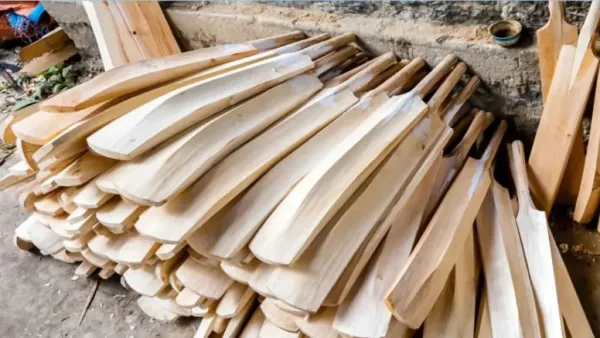
Delhi: The countries in the world where cricket is played and the increasing number of people playing cricket in them, on one hand is a proof of the growing popularity of cricket, on the other hand it is also revealing a problem which no one is paying attention to. More players also require more sports equipment. The biggest impact is on cricket bats because better cricket bats are made only from a special willow wood. Its trees are not found everywhere. Due to the shortage of willow its price is increasing and believe me many international players are playing with such bats which are worth lakhs of rupees.
Therefore, the search for alternatives has been going on in the last few years. Bats made of ordinary wood have an impact on the game. The rules of cricket do not allow the use of plastic or synthetic bats. In such a situation, there is a new option: Bambu i.e. bamboo bat. Changing weather, changing land use and rising prices are all impacting the supply of English and Kashmir willow – making bamboo bats a good research topic in the search for an alternative to traditional bats.
These days, Dr. Darshil Shah, Associate Professor of Material Science and Design at Cambridge University, is supporting the use of bamboo bat as a campaign. He made a cricket bat from laminated bamboo for the first time in 2019, from leftover bamboo pieces from a laminated bamboo project used for buildings to reduce costs. His work has now become the topic of an interesting experiment to find a new path for the future of cricket.
According to a study, at present there are about 20 crore regular cricketers in the world. In the UK alone, about 5 lakh willow clefts (the piece of wood needed to make bats) are made every year, while in Kashmir between 15 lakh and 30 lakh. If one bat is made from one cleft, it can be assumed that this supply does not meet the requirement. On the other hand, in Kashmir, instead of planting new trees of such wood, the forests in which these trees exist are also being cut down so that fast growing trees are planted in place of willows and by getting more wood, there is more earning as compared to willows.
Due to this, the price of willow has increased rapidly. The price of willow cleft which was around Rs 7000 a few years ago, is now around Rs 15000. There is a direct impact on the price of the finished bat. This is where the discussion of bamboo becomes more interesting. Unlike willow, bamboo grows rapidly and is a prolific grower in parts of Asia, South America, and Africa. Coincidentally, cricket is growing rapidly in these places only. The price of bamboo cleft is currently coming between Rs 400 to Rs 2500.
This cut piece of bamboo is not a bamboo bat, because bamboo is hollow. This is the biggest challenge in making its bat. Since a solid cricket bat is required, the bamboo is cut into strips and laminated, that is, by joining and gluing together, the blade of the bat is made. After this, this bat can be given the correct shape like making a common willow bat. Shah and the experts working with him on this project prepared their prototype in collaboration with bat manufacturing company 'Garrard & Flack'.
Everything did not go well at all. These were heavier than willow bats, they gave about 30 percent more rebound on the ball. Result: The researchers removed some material, changed the design and also the method of adhesion. The bat obtained after these improvements is very similar to the willow bat. A former professional cricketer recently batted with this prototype and while he found it a bit “board-like” (stiff), he did feel a good 'sweet spot' (the part of the bat where the shot is best) when the ball was hit.
The indication in the discussion above so far is that these bats should be used because they are cheap. The fact is that laminated bamboo bats are stronger and can provide more energy to the ball. Also, currently cricket laws do not allow its use because laminated material has been used. However, the situation is changing now.
Following an emergency cricket bat conference in October 2025, the MCC changed the law to allow certain types of recreational bats to be made from three pieces of wood. This allowed more of the tree to be used and was a response to growing concerns about willow. Still, the challenge for the bamboo bat, which requires multiple laminated strips to make it, is not over. Now looking for the answer to the same.
Contact to : xlf550402@gmail.com
Copyright © boyuanhulian 2020 - 2023. All Right Reserved.