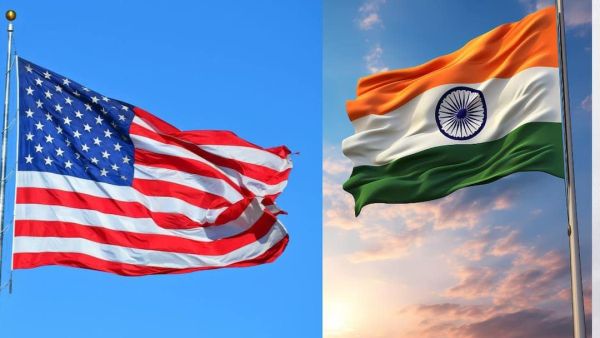
India's long-awaited bilateral trade agreement with the United States is close to being wrapped up, with Commerce Secretary Rajesh Agrawal indicating on Wednesday that the two sides are now down to a handful of outstanding issues before the deal can be signed.
Speaking to reporters on the sidelines of the Global Fintech Summit in Mumbai, Agrawal offered the clearest signal yet that Washington is building a tariff structure designed to give Indian exporters an edge over competing nations, reported The Financial Express.
A preferential tariff structure in the works
"There is a requirement that any deal has to give you certain kind of preferential access on each other's part," Agrawal said, explaining that India's position on the Most Favoured Nation (MFN) tariff system makes this relatively straightforward from New Delhi's end. The US, by contrast, operates on executive tariffs, meaning Washington is "building an architecture which will create those differentials and create a preferential market access," he said.
New Delhi has repeatedly stressed in recent weeks that securing a competitive tariff advantage for Indian exporters was non-negotiable for finalising an interim pact with Washington. Agrawal's remarks mark the first time a senior government official has confirmed that the US side is actively working towards this outcome, a development with direct implications for India's key rivals in the American market, including Bangladesh, Vietnam, Indonesia and Malaysia.
Why the tariff map keeps shifting
The emerging US framework rests on tariffs imposed under Section 301 of the Trade Act and Section 232 of the Trade Expansion Act, among other instruments. This shift followed a US Supreme Court ruling that struck down the reciprocal tariffs which had previously varied by trading partner and underpinned earlier rounds of deal-making.
India and the US had announced the framework for the first phase of the agreement back in February, but the Supreme Court's intervention on reciprocal tariffs subsequently reopened talks between the two sides, requiring fresh negotiation on terms.
Discussions are set to continue later this month, with Commerce and Industry Minister Piyush Goyal travelling to the US in late September for the G-20 Trade Ministerial in Milwaukee, where he is expected to hold bilateral talks with US Trade Representative Jamieson Greer on outstanding elements of the pact.
Trade holds steady despite the wait
The prolonged negotiations have not stalled trade flows in the interim. Indian exports to the US rose a modest 0.92% year-on-year to $87.3 billion in 2025-26, even as US tariff policy swung considerably over the period. The momentum has continued into the current financial year, with exports between April and July up 3% to $34.4 billion, according to Agrawal.
Freight costs squeeze exporters
Asked about rising freight rates and container shortages linked to disruption in West Asia, Agrawal acknowledged that the challenge was not unique to India. "All countries are facing this issue and these costs are being passed on to buyers," he said, adding that the government's immediate focus was ensuring exporters had adequate access to ships and containers so that cargo was not held up.
"Then the second option is to create how much we can ensure that their costs are competitive, the cargo times are minimal," he added.
Services exports set to outpace goods
Earlier in his address, Agrawal noted that India's services exports had been expanding at 8-10% annually, a pace he suggested could see the sector overtake goods exports in due course. Sustaining that growth, he said, would require diversifying beyond the current concentration in IT and IT-enabled services, which together account for roughly 50% of services exports, with professional services contributing a further 30%.
Fintech as the next growth lever
Turning to financial services, Agrawal pointed to the scale of the opportunity still untapped by India. Global financial services trade now exceeds $670 billion, he said, yet India's share amounts to only around $8 billion, roughly 1.2-1.3% of the global total. "That is where I think Fintech can actually make the change," he said.
Agrawal cited the cross-border payments market, currently valued at $180-190 billion and projected to reach $360 billion by 2032, alongside the cards and payments market, worth around $1 trillion today and expected to grow to $1.5 trillion by 2028-29, both sectors he said were expanding at 9-10% a year.
He added that India's experience in building fintech infrastructure at population scale gave it a distinctive advantage as it looks to extend these services internationally.
Contact to : xlf550402@gmail.com
Copyright © boyuanhulian 2020 - 2023. All Right Reserved.