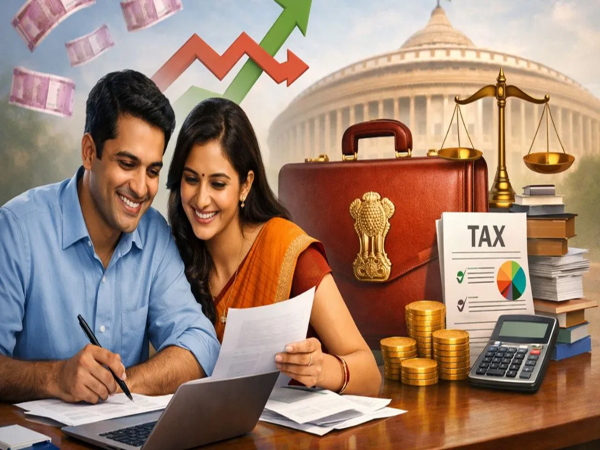
Budget 2026: Budget season has arrived, and as every year, the eyes of millions of taxpayers across the country are fixed on Finance Minister Nirmala Sitharaman's budget speech. While not much relief is expected from the general budget to be presented on February 1, 2026, as the government had already provided significant relief last year by making annual incomes up to Rs 12 to 15 lakh tax-free, this time the discussion is not about changing tax slabs, but about a revolutionary change in the way taxes are filed. According to reports, the government may introduce a major reform in its taxation policy, which will directly affect married couples and especially those families where only one member is the breadwinner.
Joint Taxation for Husbands and Wives
The biggest news emerging is the possibility of a ‘joint taxation policy’. Currently, in India, the rule is that every individual has to pay tax on their income separately, whether married or single. Husbands and wives have to file separate tax returns based on their respective incomes. However, it is believed that this time the government may give married couples the option to file their income tax returns (ITR) jointly.
This system is already in place in developed countries like the US and the UK. There, couples have the option to combine their incomes and file taxes together. If this proposal is approved in India, it will not only simplify paperwork for working couples but will also prove to be a significant step from a tax planning perspective.
Will this save on taxes?
The deepest impact of this potential decision will be on Indian families that rely on a ‘single income’. Even today, a large number of families in India have only one earning member, while the other partner manages the household. Under the current rules, the entire tax burden falls on the earning member. The tax exemption limit of the non-earning partner goes unused because they have no income. If the government allows joint tax returns, even families with only one earning member will be able to benefit from their spouse's tax exemption limit. This means that the tax will be calculated on the family's total income, significantly reducing the tax burden and potentially saving lakhs of rupees. This would be a lifeline for families struggling to make ends meet on a single salary during these times of high inflation.
The End of the Old Tax Regime
Amidst these positive developments, the government also intends to phase out the old tax regime. Statistics show that approximately 72 percent of taxpayers in the country have already shifted to the New Tax Regime. Therefore, the government plans to completely eliminate the old tax regime in a phased manner within the next five years.
The government understands that ending the old system might upset some people, so to balance this, it may increase the standard deduction. There are discussions that the standard deduction limit for salaried individuals could be increased from ₹75,000 to ₹1 lakh. In other words, while the old system will be phased out, the scope of exemptions under the new system will be expanded.
Disclaimer: This content has been sourced and edited from Amar Ujala. While we have made modifications for clarity and presentation, the original content belongs to its respective authors and website. We do not claim ownership of the content.
Contact to : xlf550402@gmail.com
Copyright © boyuanhulian 2020 - 2023. All Right Reserved.