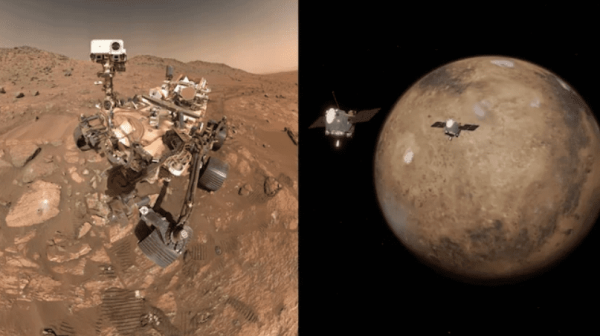
New discoveries have shown that Mars planetwhich is about half the size of the Earth and one‑tenth the mass, of Far-reaching effects on climate cycles on Earth is—especially on the cycles that control ice ages over centuries and millions of years.
Planetary physics expert at the University of California, Riverside stephen cane In a simulation study conducted by NASA, it was shown that the gravity of Mars is less than that of Earth. Milankovitch cycles Affects —these are the cycles that change the Earth’s orbit, eccentricity, and axial tilt. These changes affect when and how much of the Sun’s energy reaches different parts of the Earth, and cause climate changes such as the freezing and melting of ice.
When researchers removed Mars from their computer models, two important climate cycles disappeared — one of about 100,000 years and the other of about 2300,000 years. This makes clear that without Mars’ gravity these cycles would not have occurred, and the long-term behavior of Earth’s climate would have been different.
The research also revealed that if the mass of Mars had increased, the time cycle of these cycles would have become shorter, causing Earth’s climate models to change more rapidly. Despite Mars’ orbit being far from the Sun, its gravity affects the Earth’s orbit and axial tilt to a substantial extent, which can be called the “overweight effect”.
Earth’s current tilt is approximately 23.5 degrees is, and it changes slightly over time. The study also found that the mass of Mars affects the rate of change in Earth’s tilt, and that a more massive Mars could have slightly stabilized Earth’s tilt.
This research indicates that even small planets can influence the climate of large planets and their nearby planets. significant impact that are possible beyond our solar system—such as the impact of small exoplanets on the climate stability of habitable planets in other celestial systems.
Contact to : xlf550402@gmail.com
Copyright © boyuanhulian 2020 - 2023. All Right Reserved.